
Contents
Possessive adjectives are used to show ownership and always go before nouns. In this reference, you will explore the different types of possessive adjectives and see examples of how they are used in sentences. You’ll also learn about common mistakes people make with possessive adjectives, like confusing “your” and “you’re” or “its” and “it’s”.
Additionally, you’ll discover the difference between possessive adjectives and possessive pronouns, which replace nouns instead of preceding them. By understanding these concepts, you can improve your grasp of the English language and use possessive adjectives more effectively.
What Is A Possessive Adjective?
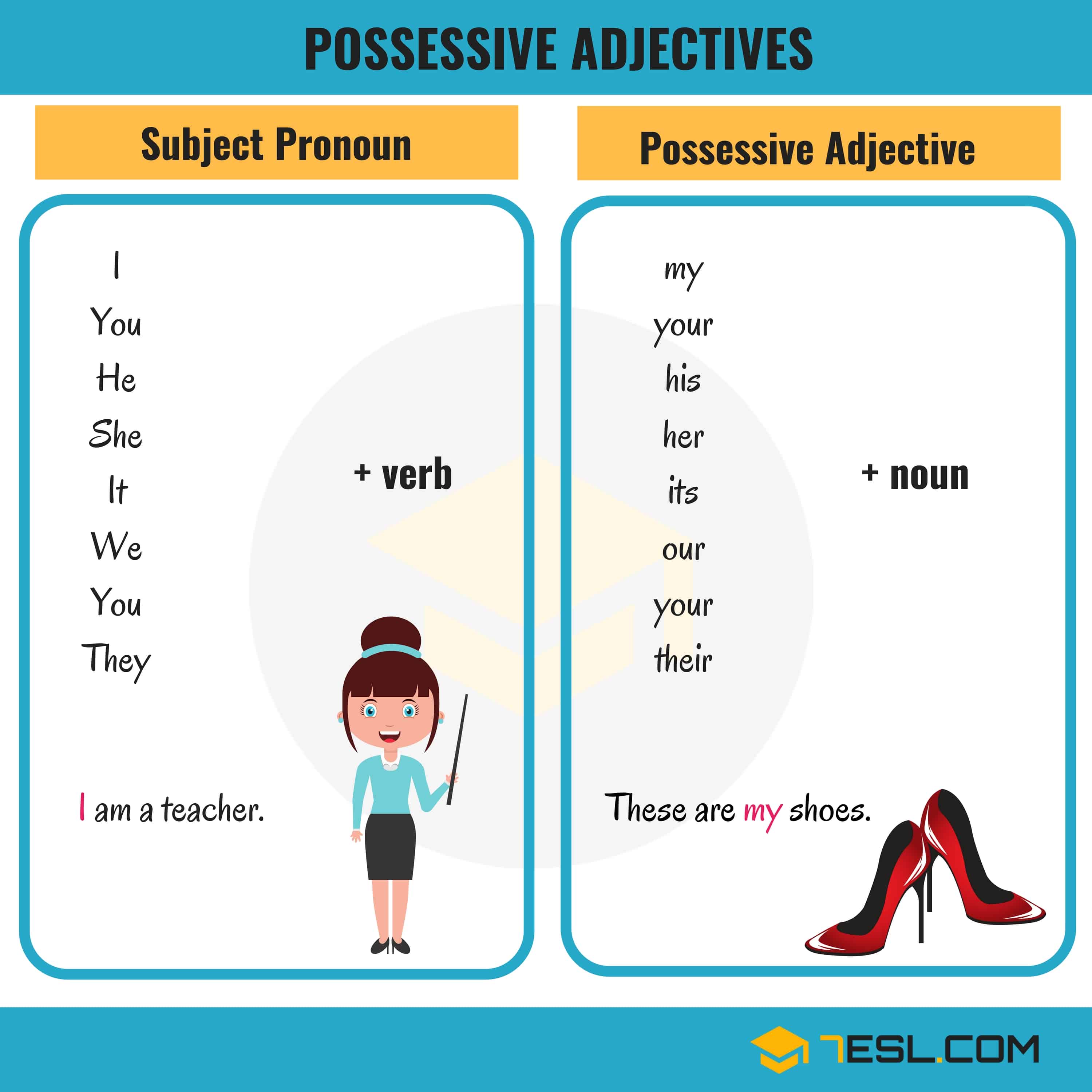
Subject Pronouns and Their Possessive Adjectives
Each possessive adjective matches a personal pronoun, as shown below:
| Possessor | Possessive Adjective | Example |
|---|---|---|
| I | my | My bag |
| You | your | Your dog |
| He | his | His shoes |
| She | her | Her tablet |
| It | its | Its color |
| We | our | Our house |
| They | their | Their cats |
Possessive adjectives can also work as pronouns. For example:
- Is this Sally’s jacket?
- No, it’s her coat.
The pronoun Sally is replaced with the possessive adjective her, which also acts as a pronoun.
Possessive Adjective Examples
- It is my pen.
- Your house is really beautiful.
- Her temper hasn’t improved with age!
- Never judge something by its looks.
- This is our website.
- Their living room is equipped with all kinds of modern appliances.
Types of Possessive Adjectives
First Person
First-person possessive adjectives are used to show possession or relationships involving the speaker:
Singular – my: represents the speaker’s possession
- Examples: my book, my job, my friend
Plural – our: represents the possession of a group including the speaker
- Examples: our house, our project, our memories
Second Person
Second-person possessive adjectives involve the person being spoken to directly:
Singular and Plural – your: represents possession by the person or people addressed
- Examples: your car, your dress, your opinions, your responsibilities
Third Person
Third-person possessive adjectives show ownership or relationships involving others:
Singular
- His: for male possession
- Examples: his wallet, his decision, his ambition
- Her: for female possession
- Examples: her bag, her skills, her family
- Its: for non-human possession (objects, animals, or concepts)
- Examples: its color, its tail, its importance
Plural – their: represents possession by a group not including the speaker or the person being addressed
- Examples: their goals, their culture, their legacy
Common Mistakes with Possessive Adjectives
Its vs. It’s
It is common to use an apostrophe with the possessive adjective “its” when it is not required. We use an apostrophe with “its” when it is being shortened from “it has” or “it is.” Since “its” as a possessive adjective does not fall into this category, it never needs an apostrophe.
Your vs. You’re
Many people confuse “your” and “you’re.” When using a possessive adjective, always use “your.” The word “you’re” is a shortened form of “you are” and should not be used as a possessive adjective.
Their, they’re, and there
Here is a simple way to remember:
- Their: Possessive adjective
- They’re: Shortened form of “they are”
- There: Refers to a location
Always use “their” as a possessive adjective. The others mean different things.
Whose vs Who’s
“Whose” is the correct form for the possessive adjective. “Who’s” is a shortened form of “who is,” and should not be used as a possessive adjective.
Use of his, her, and its
When discussing people in general, it is common to confuse “its” with “their.”
Each parent is in charge of his or her own child.
This sentence is somewhat wordy; however, using “its” here is incorrect.
Each parent is responsible for its own child. (incorrect)
Instead, you should use:
Each parent is in charge of their own child.
Possessive Adjectives vs. Possessive Pronouns
Possessive adjectives, such as my, your, his, her, its, our, and their, come before a noun to show ownership or a relationship. For example:
- This is my book.
- She is wearing her coat.
- They love their new home.
Possessive pronouns, on the other hand, replace both the noun and the possessive adjective to avoid repetition. The possessive pronouns are mine, yours, his, hers, its, ours, and theirs. For instance:
- This book is mine.
- The coat is hers.
- The new home is theirs.
It is key to use these correctly to make your communication clear. Here’s a table that shows the differences:
| Subject | Possessive Adjective | Possessive Pronoun |
|---|---|---|
| I | my | mine |
| you | your | yours |
| he | his | his |
| she | her | hers |
| it | its | its |
| we | our | ours |
| they | their | theirs |
Subject Pronoun vs. Possessive Adjective
Subject pronouns are I, you, he, she, it, we, they. They usually come before a verb.
Examples:
- He is an English teacher.
- They want to learn Chinese.
Possessive adjectives are my, your, his, her, its, our, their. These come before a noun (her hair) or an adjective + noun (her new hair).
Features:
- No singular or plural forms
- Used with both singular and plural nouns (his ball, his balls)
Structure:
- Subject pronouns + verb
- Possessive adjectives + (adjectives) + noun
The possessive adjective shows who owns the noun.
Examples:
- Her book is new.
- Their house is big.
Avoid common mistakes by learning these rules.

- Active vs. Passive Voice Exercises – Active vs. Passive Voice Worksheet - December 25, 2023
- Phrase Exercises – Phrase Worksheet - December 23, 2023
- Sentence Exercises – Sentence Worksheet - December 23, 2023
That’s very good to send my students.Thanks a lot!
You are amazing!
Thanks for doing this wanderful page. I appreciate your help. Greets from Chile.